The camera flies to every city where the hookah changed. The map changes with the years: an old chart, a printed map, then a city at night. Small numbers lead to the sources at the bottom.
Buttons, arrow keys, swipe, or click a pin on the map.
Stop 1 of 14
Persia (Safavids) · Isfahan
The first reliable traces
Illustration: Persian qalyan
Local nameqalyan
Tobacco was reportedly brought to Persia by the Portuguese in the early 16th century.3
The poet Ahli Shirazi (d. 1535) mentions the qalyan, but Encyclopaedia Iranica notes there is no evidence of the water pipe before the 1560s. Something else may have been smoked.2
Shah Abbas I (r. 1588-1629) disliked tobacco and banned it, yet people kept using it.3
Stop 2 of 14
India (Mughals) · Agra and Fatehpur Sikri
Tobacco reaches Emperor Akbar's court
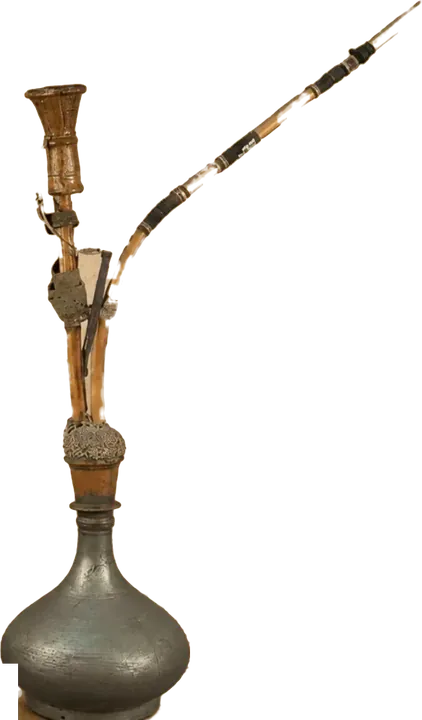
Illustration: huqqa with a long hose
Local namehuqqa
Asad Beg, Akbar's envoy to Bijapur, returned in 1604 with tobacco and a jewelled pipe and offered them to the emperor.1
Tradition says the court physician Abul-Fath Gilani came up with "purifying" the smoke through water. It is a story, not a document.12
The word hookah comes via Hindustani huqqa from the Arabic ḥuqqa, the vessel of a water pipe.6
Stop 3 of 14
Ottoman Empire · Istanbul
A fire, coffeehouses and the death penalty
Illustration: narghile with a glass vase
Local namenargile
According to historian Refik Ahmet Sevengil, tobacco reached Istanbul around 1600.12
In 1633 a great fire in the Cibali quarter, started by a man who fell asleep with his pipe on a boat, destroyed more than 20,000 homes.9
Sultan Murad IV closes the coffeehouses and introduces the death penalty for smoking tobacco in public.910
Stop 4 of 14
India (Deccan) · Bidar
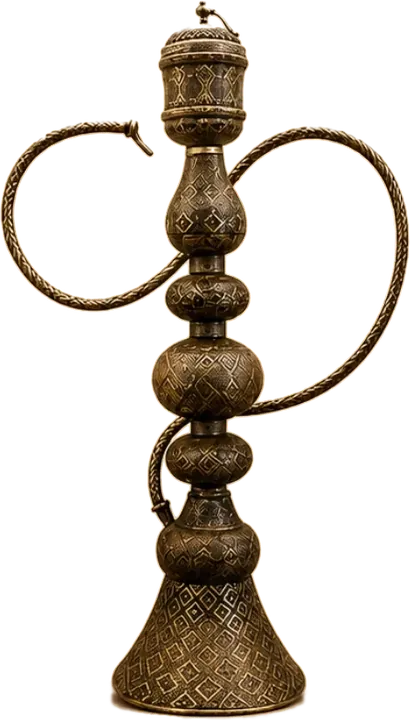
Bidri: the hookah as art
Illustration: bidri huqqa base
Local namehuqqa
In the city of Bidar, huqqa bases were made of zinc alloy, engraved and inlaid with brass. The technique is named bidri after the city.7
The Metropolitan Museum in New York holds such a base with irises from the late 17th century (acc. no. 1984.221).7
Early Bidar bases are almost always spherical; only one or two ovoid examples are known.8
Stop 5 of 14
Egypt · Cairo, Khan el-Khalili
A café open for over two centuries
Illustration: glass shisha
Local nameshisha
El Fishawy café in the Khan el-Khalili bazaar opened in 1771 or 1797, depending on the source, and has been run by the same family for generations.202119
Nobel laureate Naguib Mahfouz was a regular and wrote parts of his famous trilogy there.2021
In 1836 Edward Lane records that wealthier Egyptians smoke the "nargila", because its water vessel is a coconut, while the glass version is called "shisha".18
Stop 6 of 14
Yemen · Sana'a
Coconut and brass
Illustration: coconut water pipe
The Amsterdam Pipe Museum holds a coconut-and-brass water pipe from 1860-1920, which experts describe as Yemenite.15
The British Museum also holds Yemeni water pipes from the 1970s.16
The word narghile comes from Persian nārgīl, coconut, because the first water vessel was a coconut shell.5
Stop 7 of 14
Persia (Qajars) · Tehran
The boycott that beat the shah
Illustration: Persian qalyan
Local nameqalyan
In March 1890 Shah Naser al-Din grants the Briton G. F. Talbot a monopoly on tobacco production, sale and export for 50 years.13
More than 200,000 people in Persia then made a living from tobacco.13
In December 1891 Mirza Hasan Shirazi issues a fatwa against using tobacco and the boycott spreads across the country. The concession is cancelled in January 1892.1314
Stop 8 of 14
Lebanon · Beirut and Tripoli
Argileh and café talk
Illustration: glass shisha
Local nameargileh
Research at the American University of Beirut describes the Beirut café of the 1950s to 1980s as a place where the city's cultural life was made.25
In Tripoli, Café Fahim, one of the oldest surviving cafés in the country, still has older men smoking argileh for hours.24
Stop 9 of 14
Egypt · Cairo
Mu'assel: flavoured tobacco
Illustration: Egyptian shisha
Local nameshisha
Mu'assel means "honeyed". It is tobacco mixed with molasses, glycerine and fruit flavours.22
By the late 20th century the hookah in the Middle East was mostly smoked by older men in cafés. From the early 1990s mild mu'assel draws in the young.2247
Some sources trace mu'assel to early 20th century Egypt, but the exact start is unknown.22
Stop 10 of 14
USA · Southern California
The hookah lounge next to campus
Illustration: modern hookah
Local namehookah
Between 1999 and 2004, 200 to 300 new waterpipe cafés opened in the USA, mostly in college towns.27
At one large university, 9.5% of students had smoked a hookah in the past 30 days (2008 study).27
California's Starbuzz presents itself in a registered trademark as "Starbuzz Tobacco since 2005".28
Stop 11 of 14
United Arab Emirates
Fruit shisha becomes big business
Illustration: Egyptian shisha
Local nameshisha
In 2006 Jordan's Al Eqbal Investment Company bought the Al Fakher factory in the Emirates for 11 million dollars.26
After the purchase the factory was automated, and the brand sells in more than 100 countries.26
In November 2020 the British fund Kingsway Capital took over Al Eqbal (owner of Al Fakher) in a deal valued at more than 1.4 billion dollars.4346
Stop 12 of 14
Bosnia and Herzegovina · Sarajevo
Back to Baščaršija
Illustration: narghile with a glass vase
Local namenargila
Baščaršija dates to 1462, when the Ottoman governor Isa-beg Ishaković built a caravanserai. It was the city's main artery for trade and social life.29
Sarajevo's tourist board writes that the nargila is very popular again after a pause of a few decades, especially in Baščaršija.30
Stop 13 of 14
Russia · Moscow
A ban and fruit mixes
Illustration: modern hookah
Local namekalyan
In 2013 Russia passes a law against smoking in public places. Restaurants, cafés and hotels get until 1 June 2014.32
According to an estimate by RestConsult, hookahs were then offered in about 40% of Moscow eateries.31
Stop 14 of 14
Germany · Berlin
The land of shisha bars
Illustration: modern hookah
Local nameShisha
There is no official count: ZDF reported more than 6,000 shisha bars in 2020, and the manufacturers' association estimated about 5,000 in 2024.3334
According to the Robert Koch Institute study (KiGGS, 2009-2012), 28.9% of teenagers aged 12 to 17 had tried a hookah, and about one in ten had smoked one in the previous 30 days.35
Because of carbon monoxide poisonings, Baden-Württemberg requires shisha venues to have proper ventilation and CO detectors.3938
Today
One smoke, the whole world
56,900 kmthat is how far the smoke travelled on this map, through 14 stops and 462 years
From Isfahan to Berlin the hookah changed its vessel, its name and its tobacco. Every trail on the map is one stop of that story.
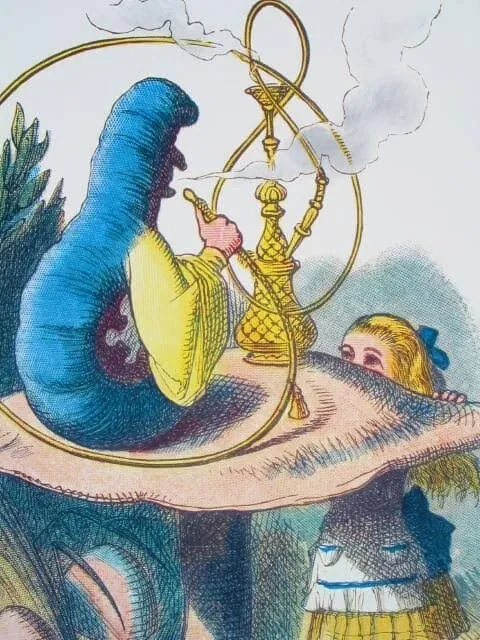
In chapter 5, "Advice from a Caterpillar", Alice finds a large blue caterpillar on top of a mushroom, quietly smoking a long hookah. The Caterpillar takes the hookah out of its mouth and asks her: "Who are YOU?"4849
Click the caterpillar
Miniature
Nobleman Smoking on a Terrace
attributed to Ali Reza
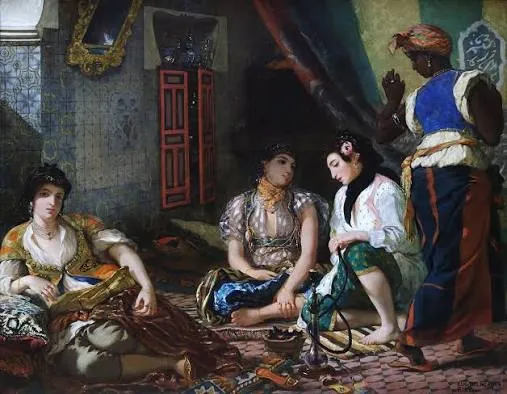
A painting from around 1670 shows a nobleman in pink smoking from a long huqqa while a courtier holds its base. The style is closer to the Deccan than to the imperial Mughal court.50
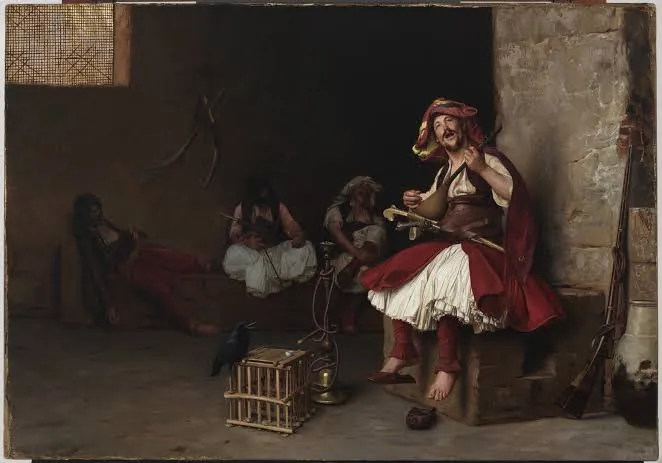
In this 1868 painting an Albanian soldier sits by a hookah playing an oud, with a raven on its cage beside him. The painting is at the Walters Art Museum in Baltimore.52
Pick a step (or swipe) and see how one part changed over time.
Fact check
Myth or truth
Read the claim, make a guess, then flip the card.
?
The water in a hookah removes all harmful substances.
Myth
Even after passing through water, the smoke contains high levels of toxic substances.40
?
The narghile is named after the coconut.
True
Persian nārgīl means coconut, and the first water vessel was a coconut shell.5
?
The hookah was invented by the physician Abul-Fath Gilani.
Unsure
That is tradition. Iranica gives his death as 1588, before tobacco reached Akbar's court in 1604.21
?
People once lost their heads for smoking.
True
In 1633 Murad IV introduced the death penalty for public smoking. The numbers executed are unreliable.910
?
Fruit-flavoured tobacco has been smoked for centuries.
Myth
Mu'assel only became popular in the early 1990s.2247
?
One hookah session equals one cigarette.
Myth
According to the WHO, one session can mean inhaling as much smoke as from 100 or more cigarettes.40
?
Shisha is an Arabic word.
Unsure
Partly: it is used in Arabic, but it comes from Persian šīša (glass), via Turkish.42
?
There is no carbon monoxide risk in a shisha bar.
Myth
A Düsseldorf clinic treated almost 40 hookah smokers for CO poisoning in a single year.38
Health
No sugar-coating
According to the WHO (2005), one hookah session can mean inhaling as much smoke as from 100 or more cigarettes.40
Water cools the smoke but does not clean it: even after the water, the smoke contains high levels of toxic substances.40
Burning coal produces carbon monoxide. After poisonings in shisha bars, some German states require ventilation and CO detectors.3839
In short
Frequently asked questions
Who invented the hookah?
The best-known story credits Abul-Fath Gilani, a Persian physician at the court of the Mughal emperor Akbar. The dates are the problem: Encyclopaedia Iranica gives his death as 1588, while tobacco only reached Akbar's court in 1604. So the legend hardly fits the facts.
Where does the hookah come from?
Nobody can say for certain. Tobacco is a plant from the Americas and reached Persia in the early 16th century. Older pipe finds in Africa show people smoked before tobacco, but they do not tell us who invented the hookah, and Iranica warns there is no reliable evidence of the water pipe in Persia before the 1560s.
Where do the words hookah, shisha and narghile come from?
Narghile comes from Persian nārgīl, coconut, because the first water vessel was a coconut shell. Shisha comes from Persian šīša, glass, via Turkish şişe, bottle. Hookah came via Hindustani huqqa from the Arabic ḥuqqa, a vessel.
Has the hookah ever been banned?
Yes, many times. Shah Abbas I banned tobacco in Persia, and in 1633 Sultan Murad IV closed Istanbul's coffeehouses and introduced the death penalty for public smoking. Today most bans are about smoking indoors, for example in Turkey since 2009 and in the Federation of Bosnia and Herzegovina since 2022.
Sources
How we know
Every claim on this page has a source. Where sources disagree, the text says so. The hookah and city illustrations are MyShishapedia drawings, not historical images.